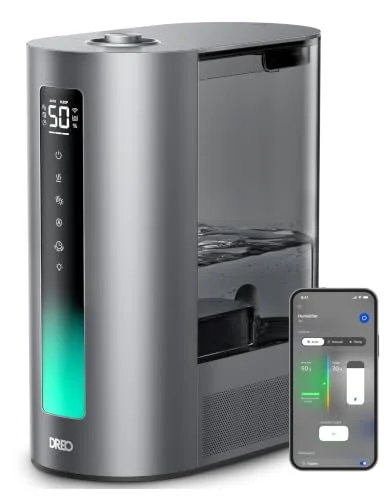
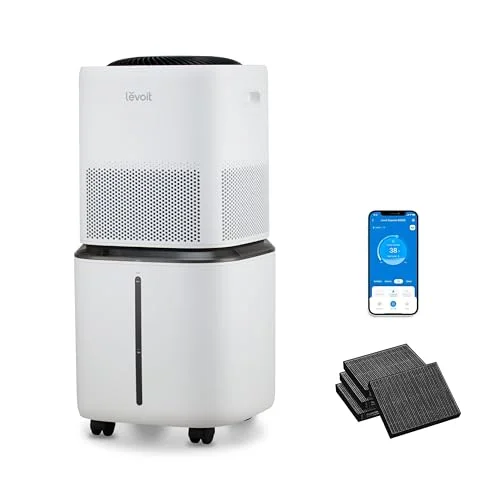
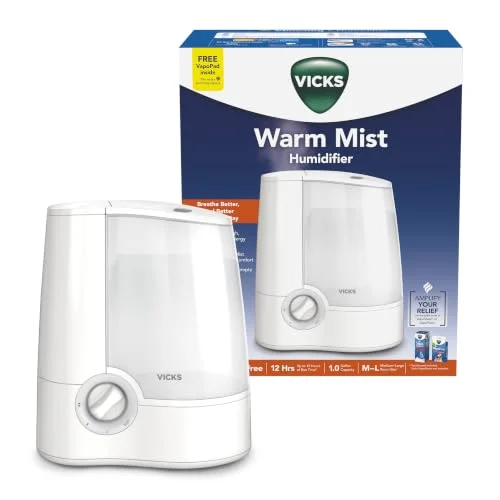
What humidity level should I keep my home at?
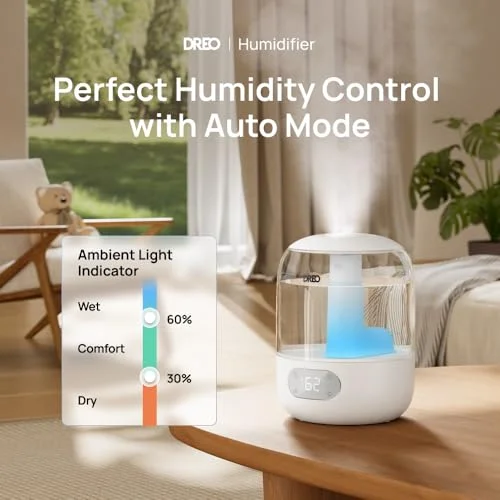
For most homes, 30 to 50 percent relative humidity. That range comes from the EPA’s guidance on mold, which recommends staying below 60 percent and ideally within it. Above 60, condensation and damp corners invite mold. In very cold weather, aim for the low end, because moist indoor air condenses on cold window glass. A humidifier’s built-in sensor reads the air right beside it, so a separate hygrometer across the room is the better guide. This is general information, not medical advice.
Cool mist or warm mist: which should I buy?
Both put the same water into the air, and once the vapor mixes into a room it neither warms nor cools it noticeably. Steam-style warm-mist units boil the water, so the minerals stay in the unit instead of becoming white dust, but they use more electricity and hold water hot enough to scald. Cool-mist units are quiet and inexpensive to run but spread tap-water minerals unless you use distilled water. Around children, the American Academy of Pediatrics recommends cool-mist humidifiers for that burn reason.
What is white dust, and how do I stop it?
White dust is the dissolved minerals in your water, mostly calcium and magnesium, carried into the room in an ultrasonic humidifier’s mist and left behind as powder when the droplets dry. The EPA’s humidifier guidance recommends low-mineral water for this reason; distilled or demineralized water stops it. Softened water does not, because a softener swaps those minerals for sodium, which also dries to a powder. Otherwise, choose a type that keeps minerals inside: evaporative wicks trap them, and steam units leave them as scale.
How often should I clean a humidifier?
More often than most people do. The EPA’s guidance for home humidifiers is to empty the tank, wipe it dry and refill it with fresh water every day, and to clean the unit every third day following the maker’s instructions. Standing water grows bacteria and mold, and a humidifier sends both into the air. Descale as often as your water demands, wash or replace evaporative wicks on schedule — Levoit says its washable wicks last up to two years at one wash a week — and dry every part before summer storage.
What size humidifier do I need for my room?
Start with output, not square feet. Among the listings we compared, units around 250 to 270 mL/h are sold for roughly 300 to 430 square feet, units from 300 to 500 mL/h for 500 to 600 square feet, and Levoit rates its 1,500 mL/h whole-house evaporative at 3,000. Tall ceilings, drafty windows and very cold weather push the real need up, and a closed door limits any humidifier to one room. Tank size tells you how often you will refill, not how large a room the unit can handle.
Are evaporative humidifiers better than ultrasonic ones?
Better at some things. Evaporative units make no visible mist and no white dust, cope with tap water, and are hard to overdo: as the air gets more humid, evaporation from the wick slows on its own. The costs are a fan you will hear at higher speeds, a wick to wash or replace, and usually a higher purchase price. Ultrasonic units are quieter at the top end, but they need distilled water to avoid mineral dust and a humidistat to avoid over-humidifying.
Can I put essential oils in a humidifier?
Only where the maker provides a place for them. Lacidoll’s 8L and BREEZOME’s 6L have built-in aroma trays, and Frida tells you to put oils on its diffuser pad, not in the water tank. Oil added straight to the water can degrade plastic parts, coat an ultrasonic plate or a wick, and interfere with a humidity sensor. If your unit has no tray or pad, leave the oils out, and if you have pets, check that an oil is safe around them before diffusing it.